


Engineering case study
Microservices Architecture Platform
Separate services. One connected platform.
A distributed sports-management platform built around domain services, an API gateway, shared identity, messaging, and relational/document data storage.
The problem
Teams, tournaments, venues, and reservations involve different business responsibilities. A service-oriented structure lets those domains have distinct modules while remaining connected through common access and communication layers.
Project context
Distributed systems / Sports management
Implementation scope
- Domain services for teams, tournaments, stadiums, users, and reservations, documented in the repository.
- API Gateway, Keycloak SSO, RabbitMQ messaging, and mixed SQL/NoSQL persistence listed in the CV.
- Docker-based deployment, Eureka discovery, and centralized Spring Cloud configuration documented in the repository.
Project showcase
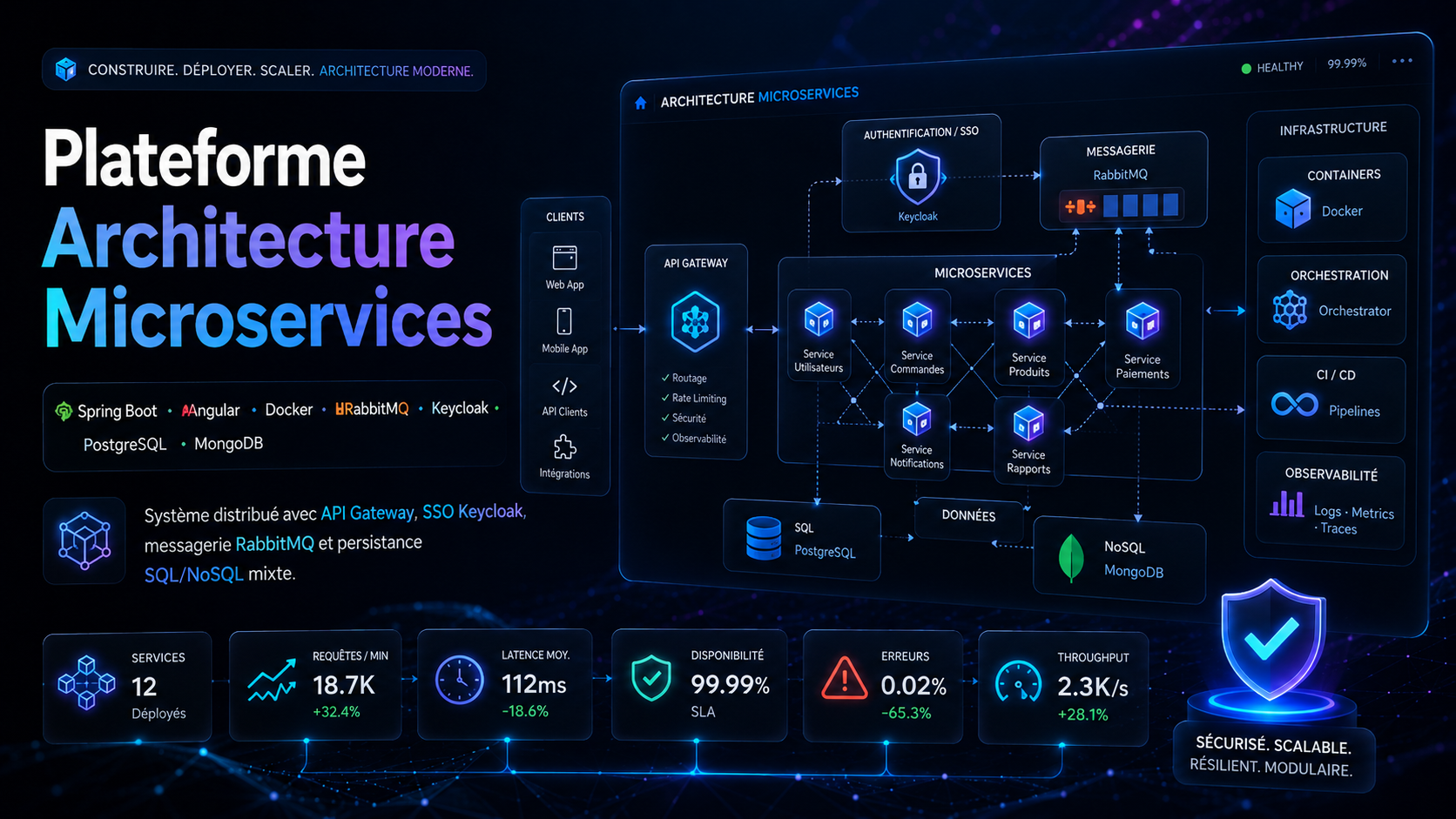
AI-generated project illustration, not an application screenshot. Any displayed metrics are illustrative.
System architecture
- 01Client
- 02Gateway
- 03Identity
- 04Services
- 05Persistence
Client & entry point
Angular / Spring Cloud Gateway
A frontend and gateway layer for reaching the platform’s domain services.
Business domains
Spring Boot / Microservices
Separate modules for team, tournament, venue, reservation, and user management.
Identity & communication
Keycloak / RabbitMQ / Eureka
SSO and messaging listed in the CV; service discovery documented in the repository.
Data & deployment
SQL / MongoDB / Docker / Spring Cloud Config
Mixed persistence and containerized services. The CV lists PostgreSQL; the public repository documents MySQL, reflecting different documented configurations.
Engineering considerations
01Organize services around business domains.
The repository separates team, tournament, stadium, reservation, and user responsibilities into modules rather than presenting one undifferentiated backend.
02Give clients a gateway entry point.
Spring Cloud Gateway provides the documented routing layer, while Eureka and centralized configuration support the service topology.
03Keep identity consistent across services.
The repository documents Keycloak, JWT, roles, and single sign-on. Authorization and token handling remain important boundaries across service calls.
Technical focus
- Domain decomposition and service-to-service integration.
- Shared identity alongside independent backend modules.
- Containerized delivery with mixed persistence and centralized configuration.
Possible extensions
Possible extensions include contract tests, tracing across service calls, and documented failure-recovery scenarios. No uptime, throughput, or latency benchmark is claimed here.